This guide has been translated from German. Prices are in euros. The providers, fees and rules mentioned apply to Germany and may differ in your country.
In short
The value of a second-hand item is what buyers are paying for it right now. The new price and asking prices in ads help hardly at all.
Most reliable are sold listings on eBay. Buy-back services show you the lower limit, listings on Kleinanzeigen rather the upper limit.
Contents
Quick check: is it worth anything?
Before you search, turn the item over. These signs show within seconds whether a closer look is worthwhile.
| You find | That means | Continue with |
|---|---|---|
| Stamp 800, 835 or 925 on cutlery | Real silver, at least material value | Calculate silver cutlery |
| Maker’s mark under a plate or cup | Maker and pattern can be identified | Identifying porcelain |
| Incised letters and numbers on the back of a doll’s head | Maker, mould and size can be identified | Antique doll value |
| Goebel mark under a figurine | Hummel figurine, age from the mark | Hummel value |
| “Lead crystal 24%” label, heavy glass | Mostly mass-produced, check glassworks names | Crystal glass value |
| Pewter plate or tankard with a percentage stamp | Mostly material value per kilo | Pewter value |
| No mark, no stamp, everyday item | Mostly flea market price | Flea market prices |
A sign alone is not yet a price. You find that with the five steps below.
Identify the item exactly
Without an exact name there is no exact price. “Old vase” finds a thousand hits between €2 and €2,000, “Rosenthal vase Studio-Linie” finds twenty that are really comparable. So look first for these features:
- Type plate and model number: on electronics, tools and kitchen appliances it is usually on the underside or back.
- Backstamp: porcelain and ceramics carry a maker’s mark on the underside and often a pattern. How to read it, using Goebel marks as the example, is shown in the guide Hummel figurines: what are they worth today?, and for tableware from Rosenthal to Meissen in the guide Identifying porcelain
- Stamps on metal: 800, 835 or 925 means real silver. A 90 or 100, on the other hand, gives the thickness of the silver coating, so the cutlery is only silver-plated. 333, 585 and 750 mark gold. How to work out the price for cutlery from that is explained in the guide Silver cutlery: what is it worth?
- Signature and back of pictures: gallery stickers, stamps and inscriptions on the back help with attribution. Under a magnifying glass you recognise prints by regular screen dots.
- Barcode and ISBN: for books, films and games the number leads directly to the right edition.
- Set numbers and maker’s marks on toys: LEGO sets have a number on box and instructions, Steiff animals a button in the ear. On Matchbox cars the base plate shows whether they come from the sought-after Lesney era, see Matchbox cars: which are valuable?
Look at sold prices instead of asking prices
What someone asks for their item says little. What counts is what buyers have actually paid. The best free source for that is the sold listings on eBay:
- Enter the exact name on eBay, as you worked it out in the first step.
- In the filters tick “Sold items”. In the eBay app the option is in the filter menu. eBay shows the list only if you are logged in (as of October 2026), a free account is enough.
- Look at 5 to 10 hits in the same condition and take the middle price, not the highest.
Two subtleties easily distort the picture. If a price is struck through or says “price offer accepted”, the real selling price was lower. And job lots, meaning several items together, do not belong in your comparison.
For some areas there are more precise sources: for vinyl records Discogs shows the sales history of every individual pressing, for trading cards Cardmarket gives current price trends.
Judge condition honestly
Condition moves the price within the range you have found. So compare only with listings in similar condition.
| Condition | Position in the range | Note |
|---|---|---|
| New, with tag or original packaging | top | Unopened collectables often above |
| Very good, barely used | upper middle | |
| Good, light signs of use | middle | The most common case |
| Clear signs of wear | lower third | Show flaws in the photo |
| Faulty or incomplete | fraction | Sell as a project item |
With games, puzzles, LEGO and model railways completeness counts more than a scratch on the box. One missing part can halve the price. How far apart the prices for Playmobil can be is shown in the guide Playmobil: finding the value and selling.
Mark out the lower and upper limit
Every source shows you a different slice of the market. Together they give a range in which your selling price lies. A quick rule of thumb from the new price is supplied by the resale value calculator, and which apps help with identifying and comparing is shown in the app comparison.
| Source | Shows you | Use |
|---|---|---|
| Buy-back services such as momox, rebuy or ZOXS | Instant price from a dealer | Lower limit: what you get with no effort |
| Sold listings on eBay | Prices actually paid | Realistic middle |
| Listings on Kleinanzeigen and Vinted | Sellers’ asking prices | Upper limit that is rarely reached |
| Auction house, specialist dealer | Assessment by specialists | For art, jewellery and antiques |
If you have time, aim for the middle up to the upper limit. If it needs to be quick, your price is closer to the lower limit. How to set the price for the individual platforms and what fees apply there is explained in the guide Finding the right price for Kleinanzeigen and Vinted.
For high values: ask specialists
For art with a signature, jewellery, high-quality watches, antiques and coin collections an online search is often not enough. Here a second opinion is worthwhile before you sell.
- Auction houses often offer free valuation days or give a first assessment from photos.
- Jewellers and coin dealers tell you their buying price. Ask several, the offers differ noticeably.
- Publicly appointed experts you find through the IHK (German chamber of commerce and industry) directory. A written valuation costs money and is worthwhile only for higher values, for example for insurance or an inheritance.
Be careful with buyers who ring unannounced or phone and want to buy jewellery, furs or coins “at the best price”. Never let yourself be put under time pressure, and get at least one comparison price beforehand.
If it is just ordinary flea market stock, on the other hand, the price table for the flea market helps you with guide values for around 50 typical items.
Frequently asked questions
How do I find out what an item is worth?
First establish the exact name from brand, model number or stamp. Then search eBay with the “Sold items” filter (only visible when logged in) for 5 to 10 comparable sales in the same condition and take the middle price.
Is there an app that estimates the value of items?
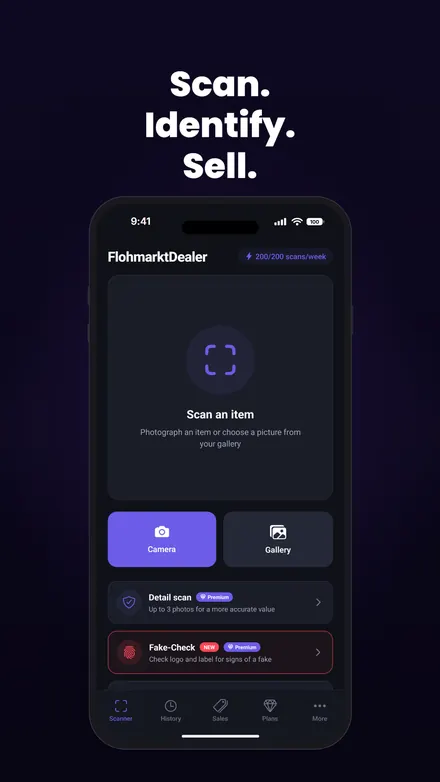
Yes. FlohmarktDealer recognises items from a photo and estimates a price range for the German second-hand market, with 3 scans a week free. For art, jewellery and antiques an AI estimate is a good starting point but does not replace specialists.
Can I have paintings valued for free?
Many auction houses give a free first assessment from photos or hold valuation days. Beforehand, check the signature and the back yourself, and with a magnifying glass whether it is a print.
How can I tell whether something is valuable?
Turn the item over and look for stamps, backstamps and labels. 800, 835 or 925 on cutlery means real silver, a maker’s mark under porcelain or a Goebel mark under figurines makes the item identifiable. Whether it is really worth anything is shown only by sold comparison listings, for example on eBay.
What is the difference between new price, current value and resale value?
The new price is what the item costs new in the shop. The current value takes age and wear into account and matters for insurance, for example. The resale value is what a buyer actually pays you today, and only that counts when selling.